

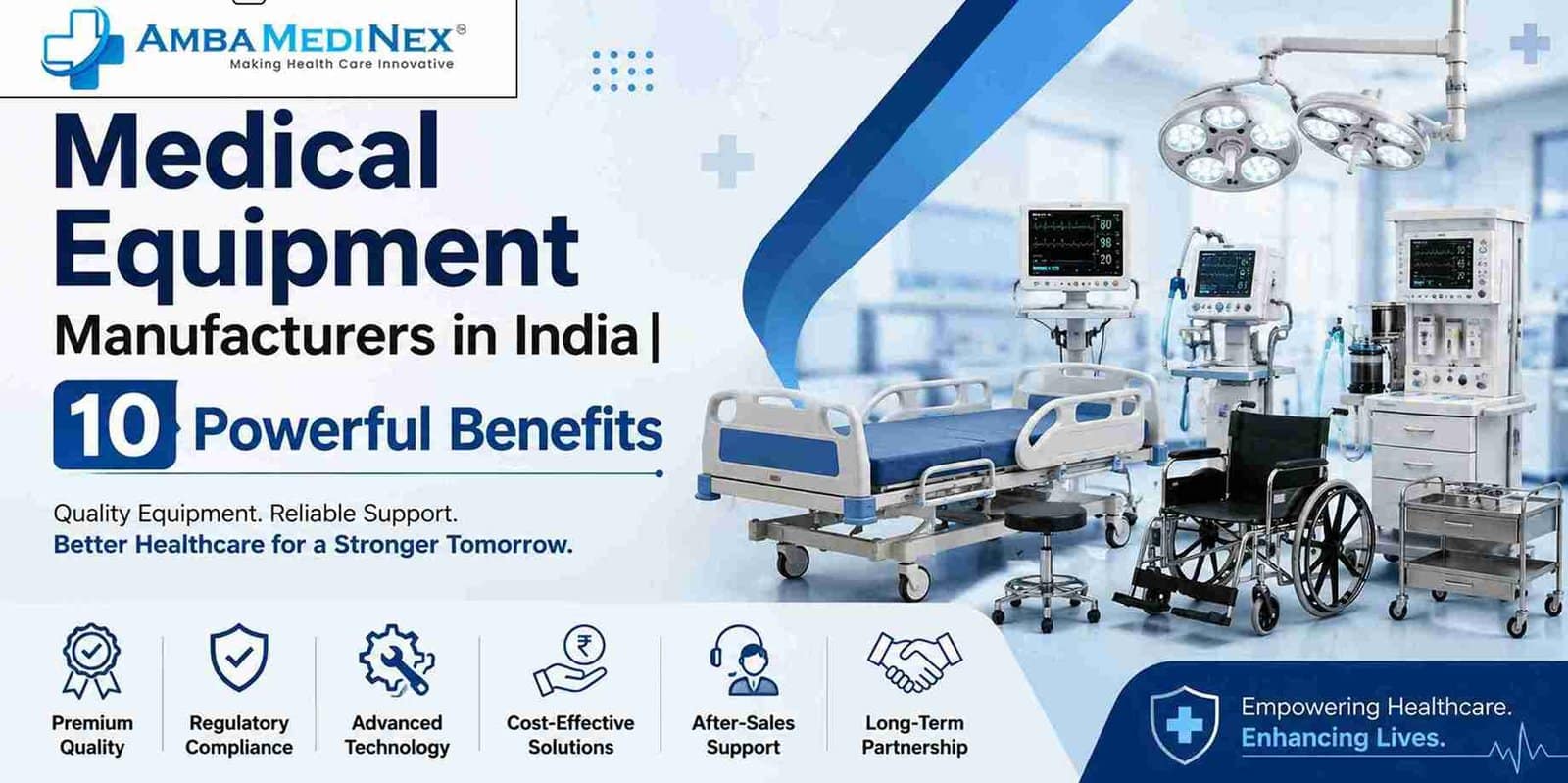
Let’s discuss about medical equipment manufacturers in India
India’s healthcare sector is evolving rapidly. Hospitals, diagnostic centers, clinics, laboratories, nursing homes, and healthcare institutions increasingly need dependable equipment that supports accurate diagnosis, efficient treatment, patient safety, and better clinical outcomes.
This growing demand has made medical equipment manufacturers in India an important part of the country’s healthcare ecosystem. From hospital furniture and critical-care equipment to diagnostic systems, surgical instruments, patient-monitoring devices, and specialized medical infrastructure, manufacturers are helping healthcare providers build stronger and more capable facilities.
However, choosing a medical equipment manufacturers in India isn’t simply about comparing prices. Medical equipment directly affects clinical operations, so quality, regulatory compliance, technical support, product availability, customization, warranty, and after-sales service all matter.
India’s regulatory framework also requires manufacturers and other stakeholders to understand applicable medical-device requirements. The Central Drugs Standard Control Organization (CDSCO) states that medical devices in India are regulated under the Drugs & Cosmetics Act, 1940 and the Medical Devices Rules, 2017. Devices are classified according to risk into Classes A, B, C, and D.
Therefore, healthcare organizations should evaluate manufacturers carefully before placing an order.
Understanding Medical Equipment Manufacturers in India
Medical equipment manufacturers in India design, develop, manufacture, assemble, test, and supply equipment used in healthcare environments. Depending on their specialization, manufacturers may produce everything from basic hospital equipment to highly sophisticated medical devices.
The industry includes manufacturers serving hospitals, laboratories, emergency departments, operating theatres, intensive care units, diagnostic centers, rehabilitation facilities, and home healthcare providers.
Some companies focus on specific product categories, while others offer broader healthcare solutions.
For example, a manufacturer may specialize in:
- ICU equipment
- Operation theatre equipment
- Hospital beds
- Patient monitors
- Medical trolleys
- Surgical instruments
- Diagnostic equipment
- Sterilization equipment
- Medical gas systems
- Laboratory equipment
- Hospital furniture
- Emergency-care equipment
- Rehabilitation equipment
- Medical disposables
The right medical equipment manufacturers in India should understand not only how to make a product but also how that product will be used in a real healthcare environment.
That’s an important distinction.
A technically impressive product isn’t necessarily the best choice if it is difficult to maintain, lacks local support, doesn’t fit the hospital’s workflow, or isn’t appropriate for the intended clinical application.
Manufacturer vs. Medical Equipment Supplier
A manufacturer and supplier aren’t always the same thing.
| Manufacturer | Supplier/Distributor |
| Designs or produces equipment | Purchases and distributes equipment |
| Controls manufacturing processes | May represent several brands |
| Can often provide customization | Usually offers standard products |
| Provides manufacturing documentation | Provides product and sales documentation |
| May offer direct technical support | Support depends on brand/manufacturer |
| Can develop project-specific solutions | Usually works with available inventory |
For large hospitals or infrastructure projects, working directly with a qualified manufacturer can offer additional advantages, particularly when customization or long-term technical support is required.
Read More – Healthcare Industry in India: Market Size, Growth & Trends
Why India’s Medical Equipment Manufacturing Sector Matters
India has a large and diverse healthcare market. As hospitals expand and healthcare infrastructure develops across metropolitan and tier-2 and tier-3 cities, the demand for dependable medical equipment continues to grow.
Domestic manufacturing can also help healthcare organizations reduce dependence on overseas supply chains for suitable products.
Moreover, local medical equipment manufacturers in India may understand Indian hospital conditions, procurement practices, installation requirements, environmental conditions, and service expectations better than an unfamiliar overseas supplier.
The regulatory environment is another important consideration. CDSCO provides dedicated information covering medical-device regulations, licensing, risk classification, testing laboratories, notified bodies, and manufacturer-related requirements.
For healthcare buyers, this means manufacturer selection should be based on more than marketing claims.
1. Product Quality and Patient Safety
Quality should be the first consideration when evaluating medical equipment.
Healthcare equipment is often used in situations where failure can have serious consequences. A hospital bed, infusion-related accessory, patient monitor, surgical device, or critical-care product must perform reliably under demanding conditions.
Good medical equipment manufacturers in India typically establish quality-control procedures covering raw materials, production, assembly, inspection, testing, packaging, and final dispatch.
What Should Buyers Evaluate?
Before purchasing, healthcare organizations can review:
- Product specifications
- Material quality
- Manufacturing processes
- Testing procedures
- Quality certifications
- Product performance
- Warranty conditions
- User manuals
- Installation requirements
- Maintenance requirements
- Traceability documentation
Medical equipment manufacturers in India should also be transparent about product limitations and intended applications.
Why Consistency Matters
Quality isn’t just about producing one good unit.
Manufacturers need to maintain consistency across batches. Hospitals purchasing equipment in volume need confidence that products supplied six months later will meet the same specifications as the initial order.
This becomes particularly important for large hospital chains and healthcare groups where standardization can simplify staff training, maintenance, procurement, and replacement.
2. Regulatory Compliance and Certifications
Regulatory compliance is a critical part of medical equipment procurement.
In India, CDSCO states that medical devices are regulated under the Drugs & Cosmetics Act, 1940 and the Medical Devices Rules, 2017. The framework uses a risk-based classification system: Class A represents low-risk devices, while Class D represents high-risk devices.
Manufacturers and buyers should therefore understand the regulatory requirements applicable to the specific product.
Important Documentation for Medical Equipment Manufacturers in India
Depending on the product, organizations may need to evaluate:
- Manufacturing licences
- Product-related regulatory documents
- Test reports
- Quality-management documentation
- Product specifications
- Certificates applicable to the device
- User manuals
- Warranty documents
- Installation records
- Calibration documentation, where applicable
CDSCO also publishes Medical Devices Rules, guidance documents, checklists, and related regulatory information for manufacturers and other stakeholders.
Important: certification or licensing requirements can differ depending on the medical device, classification, intended use, and applicable regulations. Buyers should verify current requirements with the relevant regulatory authority rather than relying solely on a supplier’s claims.
3. Wide Range of Medical Equipment
A manufacturer with a broad product portfolio can simplify procurement for healthcare organizations.
Instead of coordinating with multiple vendors, hospitals may be able to source several related products from one established manufacturer.
Common Product Categories
| Category | Examples |
| Critical Care | ICU beds, patient monitors, ventilator-related equipment |
| Operation Theatre | OT tables, surgical lights, equipment trolleys |
| Patient Care | Hospital beds, bedside lockers, examination couches |
| Diagnostic | Diagnostic instruments and monitoring systems |
| Laboratory | Laboratory furniture and testing equipment |
| Sterilization | Sterilizers and supporting equipment |
| Emergency Care | Emergency trolleys and resuscitation equipment |
| Hospital Infrastructure | Medical gas and related systems |
| Rehabilitation | Mobility and therapy equipment |
| Consumables | Selected medical disposables and accessories |
However, a larger product catalog doesn’t automatically mean better quality.
Buyers should assess the specific products relevant to their needs and evaluate the manufacturer’s expertise in those categories.
Read More – Classification of Operation Theater: Structure, Function & Standards
4. Customization and Project-Based Solutions
Every hospital isn’t designed the same way.
A large tertiary-care hospital may have very different requirements from a small nursing home or diagnostic center. Even departments within the same hospital can have different workflows.
That’s where customization becomes valuable.
Experienced manufacturers may provide solutions based on:
- Available floor space
- Department layout
- Patient capacity
- Workflow requirements
- Equipment dimensions
- Electrical requirements
- Infection-control considerations
- Installation conditions
- Budget
- Future expansion plans
Customization Can Improve Efficiency
For example, a hospital may require equipment with specific dimensions to fit an existing room. A standard product may technically work but create workflow difficulties.
A customized solution can potentially improve:
- Space utilization
- Staff movement
- Equipment accessibility
- Storage
- Patient handling
- Department workflow
This is especially useful for new hospital projects, modular departments, ICU expansions, operation theatres, and specialized healthcare facilities.
5. Advanced Manufacturing Technology
Technology is transforming medical equipment manufacturing.
Modern medical equipment manufacturers in India increasingly use digital design tools, automated production techniques, precision machining, improved material technologies, and structured quality-control systems.
Technology Can Improve:
- Manufacturing precision
- Product consistency
- Production efficiency
- Design flexibility
- Testing capabilities
- Traceability
- Product development
For advanced medical devices, technology may also extend into embedded electronics, sensors, software, connectivity, and data management.
CDSCO’s medical-device resources currently include guidance related to medical-device software, reflecting the increasingly technical nature of the medical-device sector.
However, technology should support clinical needs rather than simply become a marketing feature.
The most useful question is: Does the technology make the equipment safer, more reliable, easier to use, or more effective?
6. Quality Control and Testing
Quality control is one of the strongest indicators of a responsible manufacturer.
A structured manufacturing process should include checks at different stages rather than relying only on final inspection.
A Typical Quality Approach
- Raw-material inspection
- Component verification
- Production-stage inspection
- Assembly checks
- Functional testing
- Safety testing where applicable
- Final inspection
- Documentation
- Packaging
- Dispatch verification
Testing requirements vary significantly by product.
Some devices may require electrical safety testing, performance testing, calibration, sterility-related controls, biocompatibility assessment, software validation, or other specialized evaluation.
India’s regulatory framework also provides for medical-device testing laboratories and related regulatory processes.
Therefore, buyers should ask manufacturers what testing is performed and whether relevant test documentation can be provided.
7. After-Sales Support and Maintenance
Buying medical equipment is only the beginning of the relationship.
Healthcare equipment requires installation, user training, maintenance, troubleshooting, spare parts, and sometimes calibration or periodic inspection.
A manufacturer with a strong after-sales network can help hospitals minimize downtime.
Evaluate These Support Services
- Installation assistance
- Product demonstration
- User training
- Preventive maintenance
- Breakdown support
- Spare-parts availability
- Technical helpline
- Service contracts
- Warranty support
- Calibration services where applicable
Why Downtime Matters
If critical equipment becomes unavailable, hospital operations can be disrupted.
For that reason, buyers shouldn’t evaluate manufacturers only on the initial purchase price. The total cost of ownership is often more important.
A cheaper product with frequent failures may ultimately cost more than a higher-quality product supported by dependable service.
Read More – AI in Healthcare – The Changing Face Of Modern Medicine
8. Cost-Effective Healthcare Equipment
Cost remains an important consideration for hospitals.
However, cost-effectiveness isn’t the same as choosing the cheapest product.
A better procurement approach considers:
Purchase price + installation + maintenance + spare parts + downtime + replacement cost = total ownership cost
Domestic manufacturing can sometimes offer cost advantages through shorter supply chains, local service networks, and reduced dependence on international logistics.
How Buyers Can Control Costs
Healthcare organizations can:
- Compare multiple manufacturers
- Request detailed quotations
- Evaluate warranty coverage
- Compare specifications
- Review maintenance costs
- Consider lifecycle costs
- Negotiate bulk orders
- Standardize equipment where practical
- Assess local spare-parts availability
The goal should be value for money, not simply the lowest invoice amount.
9. Domestic Manufacturing and Faster Supply
One of the major advantages of choosing suitable Indian manufacturers is proximity.
When products are manufactured domestically, communication, site visits, installation coordination, technical support, and logistics may be easier.
This can be especially valuable for large hospital projects where equipment delivery must follow a construction or commissioning schedule.
Potential Advantages
- Faster communication
- Local technical teams
- Easier factory visits
- Better customization discussions
- Reduced shipping complexity
- Faster spare-parts access
- Easier coordination during installation
For healthcare infrastructure projects, these factors can make a meaningful difference.
10. Long-Term Partnership and Scalability
The best manufacturer isn’t necessarily the company that makes the biggest sale today.
A strong manufacturing partner should be able to support a healthcare organization as its requirements grow.
For example, a hospital may initially require equipment for 50 beds but later expand to 100 or 200 beds.
A reliable manufacturer can help maintain product consistency during expansion.
Long-Term Partnership Can Include:
- Repeat procurement
- Product standardization
- Equipment upgrades
- Customized solutions
- Maintenance contracts
- Spare-parts support
- Training
- New department setup
- Expansion projects
This approach can simplify procurement and reduce operational complexity over time.
Types of Medical Equipment Manufactured in India
The Indian medical manufacturing ecosystem covers a wide range of products.
Hospital Furniture
This may include:
- Electric hospital beds
- Manual hospital beds
- ICU beds
- Examination couches
- Bedside lockers
- Patient stretchers
- Wheelchairs
- Medical trolleys
Critical-Care Equipment
Critical-care environments require reliable equipment designed for demanding clinical situations.
Products can include patient-monitoring equipment, ICU furniture, emergency equipment, and related accessories.
Operation Theatre Equipment
Operation theatres may require:
- OT tables
- Surgical lights
- Instrument tables
- Surgical trolleys
- Anesthesia-related equipment
- Equipment cabinets
- Specialized OT accessories
Diagnostic and Laboratory Equipment
Manufacturers may also serve diagnostic centers and laboratories with instruments, workstations, storage systems, and related equipment.
Medical Infrastructure
Some manufacturers specialize in hospital infrastructure solutions such as medical gas pipeline components, modular healthcare systems, and specialized clinical environments.
Read Related – Operation Theatre Technician: A Complete Guide
How to Choose the Right Medical Equipment Manufacturer
Selecting a manufacturer should be a structured process.
Step 1: Define Your Requirements
Prepare a detailed list of:
- Equipment type
- Quantity
- Technical specifications
- Intended application
- Installation location
- Required delivery timeline
- Budget
- Service expectations
Step 2: Shortlist Manufacturers
Review manufacturers based on:
- Industry experience
- Product portfolio
- Manufacturing capabilities
- Quality systems
- Regulatory documentation
- Customer support
- Project experience
Step 3: Verify Product Documentation
Don’t rely only on brochures.
Request appropriate technical and regulatory documentation for the products being considered.
Step 4: Evaluate Manufacturing Capability
Where practical, consider a factory visit.
A visit can help buyers understand:
- Production capacity
- Quality-control procedures
- Storage conditions
- Testing facilities
- Manufacturing technology
- Workforce capabilities
Step 5: Compare Total Value
Compare manufacturers based on quality, service, compliance, delivery, warranty, customization, and lifecycle cost – not just price.
Questions to Ask Before Selecting a Manufacturer
Before signing a purchase agreement, ask:
- How long has the manufacturer been operating?
- What medical equipment categories do they specialize in?
- What manufacturing facilities do they operate?
- What quality-control processes are followed?
- What regulatory approvals or licences apply to the products?
- Can relevant test reports and documentation be provided?
- Is customization available?
- What is the expected delivery timeline?
- What warranty is included?
- Is installation included?
- What after-sales support is available?
- Are spare parts readily available?
- Is preventive maintenance offered?
- Can references from similar healthcare projects be provided?
- What happens if the equipment requires urgent service?
These questions can help separate established, service-oriented manufacturers from companies focused mainly on short-term sales.
Importance of Documentation and Technical Support
Medical equipment procurement involves more documentation than a typical commercial purchase.
Depending on the product and applicable regulations, documentation can include product specifications, manuals, licences, test reports, warranty information, installation records, service documentation, and other technical materials.
Proper documentation helps healthcare organizations with:
- Procurement records
- Staff training
- Maintenance
- Audits
- Troubleshooting
- Product traceability
- Regulatory compliance
- Future replacement
CDSCO maintains guidance and checklists covering several medical-device regulatory processes, including manufacturing, importing, testing, and other activities.
A professional manufacturer should therefore have a systematic documentation process.
Read Related – Operation Theatre Technology – A Complete Guide to OT Technology
Role of Medical Equipment Manufacturers in Modern Healthcare
Medical equipment manufacturers in India do much more than produce physical products.
They contribute to the healthcare ecosystem by supporting innovation, hospital expansion, clinical infrastructure, local technical expertise, and product availability.
Their role becomes even more important as healthcare moves toward:
- Digital monitoring
- Connected medical devices
- Remote diagnostics
- Smart hospital infrastructure
- Advanced surgical systems
- Point-of-care testing
- Home healthcare
- Personalized treatment
- Data-driven clinical workflows
At the same time, manufacturers need to maintain a strong focus on patient safety and responsible product development.
Healthcare technology should ultimately serve doctors, nurses, technicians, patients, and caregivers.
Future of Medical Equipment Manufacturing in India
The future of India’s medical equipment industry looks promising.
Healthcare infrastructure is expanding, and demand for modern medical technology is increasing. At the same time, hospitals are becoming more conscious of lifecycle costs, equipment standardization, service support, and technology integration.
Key Trends to Watch
- Smart Medical Equipment
Connected devices can help healthcare professionals collect and monitor information more efficiently.
- AI-Enabled Healthcare Technology
Artificial intelligence may increasingly support diagnosis, monitoring, workflow management, and clinical decision-making, although its application must be appropriate and properly validated.
- Local Manufacturing
Domestic manufacturing is likely to remain strategically important for supply-chain resilience and healthcare accessibility.
- Modular Healthcare Infrastructure
Modular approaches can help hospitals develop or expand specialized environments more efficiently.
- Sustainable Manufacturing
Manufacturers are also likely to face increasing expectations around energy efficiency, material selection, waste reduction, and responsible manufacturing.
- Digital Medical Devices
Software, connectivity, cybersecurity, and data interoperability will become increasingly important as healthcare equipment becomes more digital.
CDSCO’s publication of guidance on medical-device software in July 2026 illustrates the continuing development of the regulatory and technical environment around modern medical devices.
Frequently Asked Questions
1. What are medical equipment manufacturers?
Medical equipment manufacturers in India are companies that design, develop, manufacture, assemble, test, and supply equipment used in hospitals, clinics, laboratories, diagnostic centers, and other healthcare environments.
2. How do I choose medical equipment manufacturers in India?
Evaluate their manufacturing capabilities, product quality, applicable regulatory documentation, testing procedures, certifications, industry experience, customization options, warranty, after-sales support, and spare-parts availability.
3. Are medical devices regulated in India?
Yes. CDSCO states that medical devices in India are regulated under the Drugs & Cosmetics Act, 1940 and the Medical Devices Rules, 2017.
4. What are the medical device classes in India?
The Medical Devices Rules use a risk-based classification system consisting of Class A, Class B, Class C, and Class D, ranging from low risk to high risk.
5. Can Indian medical equipment manufacturers provide customized products?
Many manufacturers offer customization, although the level of customization varies by company and product. Buyers should discuss technical requirements, dimensions, materials, functionality, quantities, and project timelines before placing an order.
6. Why is after-sales service important for medical equipment?
Medical equipment may require installation, maintenance, troubleshooting, spare parts, training, and periodic servicing. Strong after-sales support can reduce downtime and help healthcare organizations maintain operational continuity.
7. Is the cheapest medical equipment always the best option?
No. Purchase price is only one part of the overall cost. Buyers should also consider reliability, maintenance, warranty, spare parts, service availability, expected lifespan, and total cost of ownership.
8. Should hospitals buy directly from manufacturers?
For some projects, direct procurement can provide advantages such as customization, technical communication, factory support, and potentially better long-term service. However, the best procurement model depends on the product and project requirements.
9. What documents should I request from a manufacturer?
Depending on the product, request applicable licences, specifications, test reports, certificates, manuals, warranty documents, installation information, maintenance instructions, and other relevant regulatory or technical documentation.
10. What makes a medical equipment manufacturer reliable?
A reliable manufacturer generally demonstrates consistent product quality, appropriate regulatory compliance, transparent documentation, manufacturing expertise, responsive service, technical support, and a commitment to long-term customer relationships.
Conclusion
Choosing among medical equipment manufacturers in India is an important decision for hospitals and healthcare organizations.
The right partner should offer more than a product catalogue and competitive pricing. Quality, safety, regulatory compliance, testing, manufacturing capability, customization, delivery, warranty, maintenance, and after-sales service all deserve careful consideration.
India’s medical-device regulatory environment provides a structured framework for medical devices, including risk-based classification and requirements covering manufacturing, testing, licensing, and related activities.
As healthcare continues to modernize, manufacturers will play an increasingly important role in providing dependable equipment and innovative solutions.
For buyers, the golden rule is simple: don’t choose a manufacturer only because the price looks good on paper. Choose a partner that can deliver quality, compliance, service, and long-term value.
That approach can help healthcare organizations make more informed procurement decisions while building safer, more efficient, and future-ready healthcare facilities.