

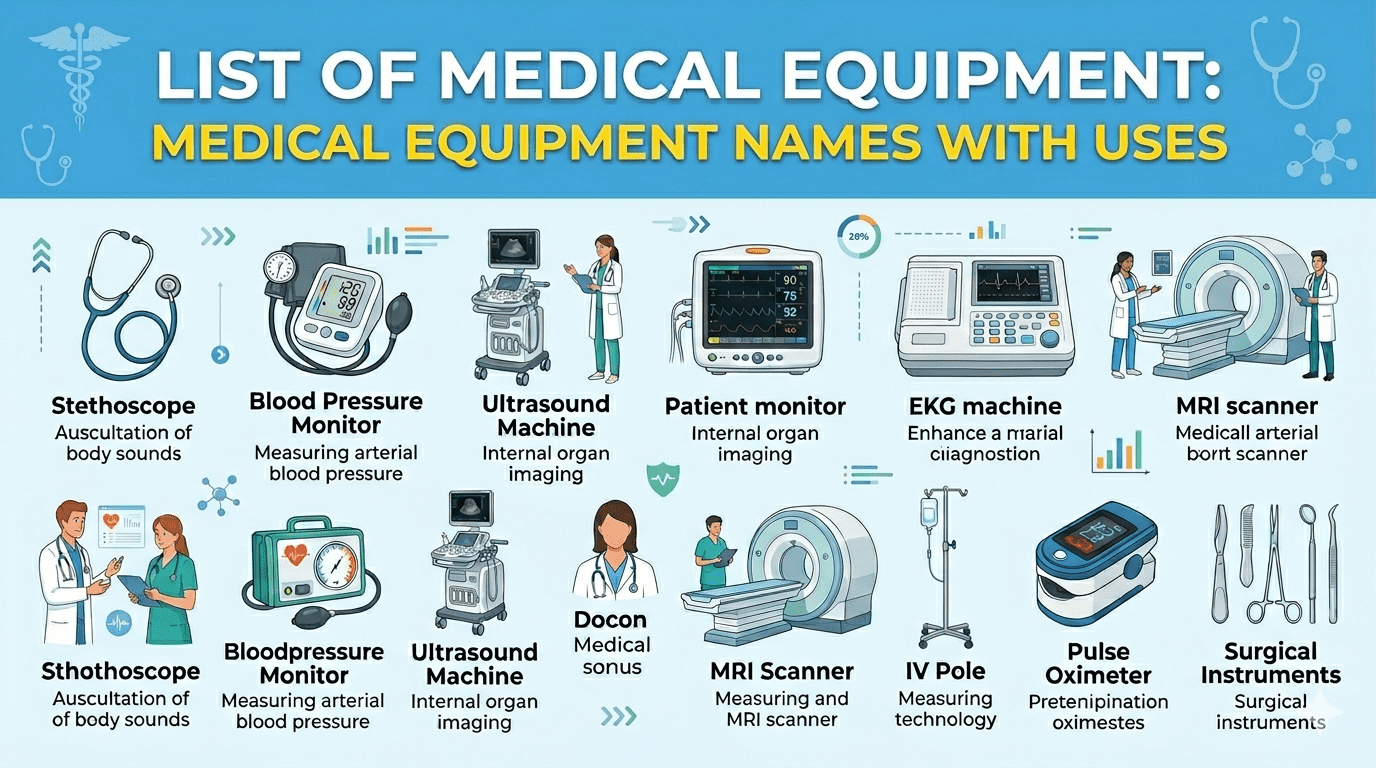
Let’s discuss the list of medical equipment used in hospitals…
Modern healthcare relies on high-quality tools and devices that enable greater diagnostic and treatment accuracy. A well-organized list of medical equipment is indispensable for any medical setup, from routine checkups to emergency care. Whether in a clinic, hospital or home health care, knowing various medical equipment names and how they are used gives you an advantage in making better decisions, as it indicates the use of equipment.
So you are not going to find this list elsewhere, as we have rewritten it from scratch in a natural way that is easy to understand.
What Exactly is a List of Medical Equipment?
The list of medical equipment is an appropriate piece of detail, listing devices that are required for a patient’s care. Well, this type of machine has everything in it, starting from diagnostic tools to advanced machines used in surgeries and in emergency care. When the correct list is maintained, the healthcare provider is always ready to provide prompt care and action whenever needed without procrastination.
Read Related – Essential Medical Equipment Checklist for Healthcare Facilities
Names and Uses of Basic Medical Equipment
Here are some examples of building blocks related to a list of medical equipment and their uses in the healthcare environment:
Stethoscope
This is one of the most simple yet effective tools out there. It can help doctors listen to internal organ sounds such as heartbeats and breathing rhythm, so they can detect potential problems during the examination as soon as possible.
Digital Blood Pressure Monitor
The device can quickly and accurately check blood pressure. It is commonly used in clinical settings and at home for routine health monitoring.
Infrared Thermometer
This more advanced thermometer does not use the traditional one but measures without contact, therefore much safer and more hygienic.
Pulse Oximeter
A miniature device that measures the oxygen saturation of blood. This is really helpful for patients with respiratory diseases.
Electrocardiogram (ECG) Machine
This machine records the electrical activity of your heart. It helps in recognizing heart issues like irregular rhythms.
Diagnostic Equipment in Healthcare
Because testing for diseases is a major part of any medical equipment list, diagnostic tools are a major part of medical equipment as well.
Ultrasound Scanner
This equipment uses sound waves to make pictures of organs. This is a mainstay in pregnancy or abdominal imaging.
X-ray System
X-ray machines create internal images of the body, which can help detect bone fractures, infections, and some tumors.
CT Scan Machine
A CT scanner gives very clear, cross-sectional pictures which are more accurate than ordinary X-rays.
MRI Machine
Utilizing magnetic fields, MRI (Magnetic Resonance Imaging) creates detailed pictures of tissues and organs, ideal for examination of the brain and spine.
Life-Support and Emergency Equipment
Some devices save lives in moments of crisis. These are the key aspects of a full list of medical equipment –
Ventilator
This machine provides support to patients who are unable to breathe on their own.
Defibrillator
In a cardiac emergency, it delivers controlled shocks to the heart to get it beating normally again.
Infusion Pump
It allows accurate infusion of fluids and drugs into the haemodynamic patient as needed over time.
Surgical Equipment Names
Surgical procedures require precision tools. The following are a few of the important list of medical equipment names and their usages in surgery:
Scalpel
A knife used for making incisions during operations.
Surgical Forceps
These are used for holding or transporting tissues during procedures.
Retractors
With the mechanical aid of retractors, doctors are able to see better since the surgical areas are wide open.
Monitoring Equipment
And they are a necessity in today’s Healthcare setups as monitoring devices keep an eye on the health of the patients continuously.
Multiparameter Monitor
It is a device that tracks heart rate, oxygen saturation, and blood pressure.
Glucometer
An instrument used for measuring blood glucose levels, especially in diabetics, a portable instrument for measuring blood sugar levels.
The Importance of a List of Medical Equipment
Organizing your hospital’s equipment and maintaining a proper medical inventory list is directly related to patient care. Here’s why it matters:
- Ensures readiness during emergencies
- Helps avoid equipment shortages
- Improves efficiency in treatment
- Supports better inventory planning
Faster, more accurate care is possible when providers can recognize list of medical equipment names and uses.
Advice on Selecting Your Medical Equipment
The tools that you choose and list out are equally important. Keep these points in mind:
- Quality and certified equipment should always be your choice
- Selecting devices depending on the requirements of your facility
- Think practicality into account
- Keep updated with modern technology
Read Also – NABH Standards and Rules Every Hospital Must Follow
Conclusion
An effective list of medical equipment is the backbone of any healthcare establishment. The medical professionals will not have the minimal knowledge about how it works ONLY AFTER DOING PRACTICALS, but many functions need to be performed practically, which is done by using specialized medical equipment. By the names of medical equipment with numbers or codes, which are to be used for minimal mistakes.
Frequently Asked Questions (FAQs)
What is a list of medical equipment?
A simple medical equipment list typically consists of a stethoscope, a thermometer, a blood pressure monitor, a pulse oximeter, and basic diagnostic equipment.
Why You Should Know the Names and Uses of Medical Equipment
Familiarity with medical equipment names and uses enables healthcare professionals to select the appropriate tools when needed, which enhances diagnosis and treatment outcomes.
What are the most important medical devices for small clinics?
The list of essential medical equipment small clinics should buy includes some of the most basic and necessary devices, such as a BP monitor, thermometer, ECG machine, glucometer, and basic surgical instruments.
What is the frequency of updating your medical equipment?
Regular inspection and calibration or replacement of medical devices is essential for accuracy, patient safety, and compliance with healthcare requirements.
Is it possible to use medical equipment at home?
Indeed, most of them, such as digital thermometers, BP monitors, pulse oximeters etc. are only meant to be used for home purposes, so they are simple to operate.