

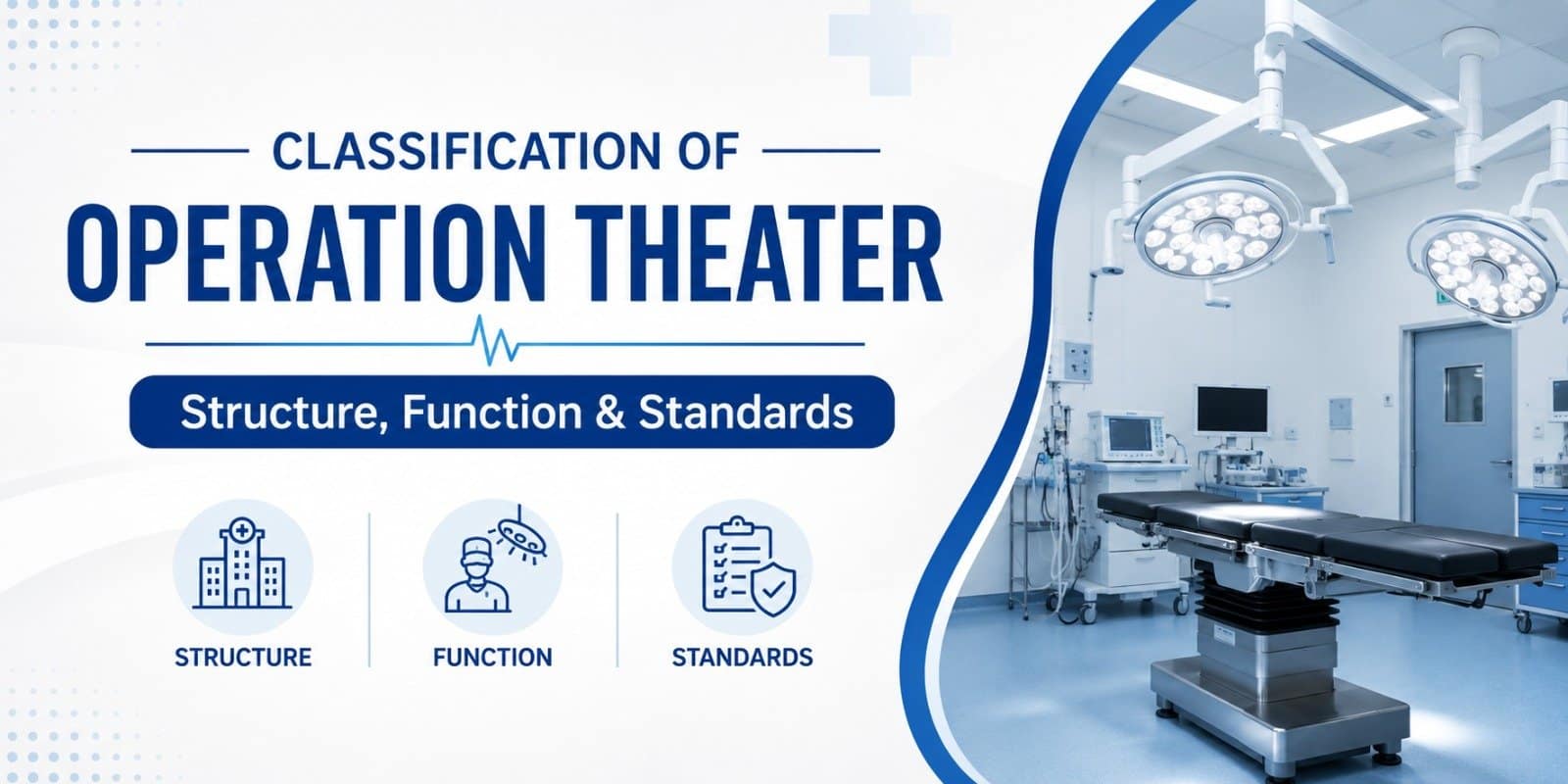
Let’s explore the classification of operation theater here…
The OT is pretty much the backbone of any hospital with respect to surgical care. However, not all OTs were created equal. The extremely varied design, equipment and sterility requirements range from basic procedures to complicated cardiac surgeries. A clear understanding of the classification of operation theater is crucial to hospital administrators, healthcare planners, architects and medical professionals who aim to provide safe and efficient surgical care.
Through this article, we will discuss the major types and classification of operation theater and their operational needs and how they could be compared with international standards followed for operation theatres in India.
Why Classification of Operation Theater Matters?
You are not an operating room, which is obviously just a table surrounded by lights in some (often gleaming) sterile semblance. An environment meticulously designed so that air quality and the positioning of equipment ensure the lives of humans are protected; infection risks are minimized, and workflows are optimized. Proper classification of OT ensures:
For each type of procedure that requires a certain level of sterility, each resource is allocated immediately without any needless overhead, in adherence to national and international health standards.
Lowered exposure to Healthcare-Associated Infections (HAIs), Not upgrading an OT (or making an incorrect claim about it) may expose a practice to surgical site infections, equipment failures and even the risk of failure to comply with regulations.
Operation Theatre Classification according to Speciality
Here are the most common classifications of ot according to the type of surgery they are for.
General Surgery OT
The most common type of theater that is used and where the bulk of abdominal, gastrointestinal, as well as soft-tissue surgery takes place. It offers standard laminar airflow, basic anesthesia workstations, and general-use surgical lights.
Orthopedic OT
Orthopedic surgeries require ultra-clean areas to avoid infections in bones. These OTs are fitted with vertical laminar airflow (LAF) systems, bone saws, C-arm imaging units and dedicated orthopedic tables.
Cardiac & Cardiothoracic OT
Cardiac OTs, among the most sophisticated ones, have heart-lung perfusion machines and high hemodynamic monitoring systems along with redundant power support systems. Stringent positive-pressure ventilation is mandatory.
Neurosurgery OT
Since neurosurgeon OTs will need intra-operative imaging (MRI-compatible or CT-room compatible) and ceilings ready for optical microscopes, this means some very specific requirements around sound-damping (vibrations) flooring and drop-points. Even the smallest trace of contamination or disturbance can produce catastrophic effects.
Obstetrics & Gynecology OT
These OTs are usually next to labour rooms so that they can be called at any point in case of an emergency C-section. They have NABH and NBE incorporated either through the hospital or other nearby establishments; similarly, they require a very fast convertibility from delivery to operation.
Ophthalmic & ENT OT
These OTs have a smaller footprint and are meant for microsurgeries (which require delicate procedures). They specialize in microscope integration, anti-vibration tables and precise lighting.
Read Also This: The Future of Artificial Intelligence (AI) in Healthcare
Classification Based on Sterility Zones
If we go on to the classification of operation theater, another important and widely used method for classification is based on sterility or on contamination risk, a.k.a zone classification.
- Zone
- Description
- Example Areas
Zone 1 – Protective Zone
General hospital access area
Corridors, waiting areas
Zone 2 – Clean Zone
Restricted access; scrubbing area
Scrub sinks, pre-op area
Zone 3 – Aseptic Zone
Sterile field; surgical team only
OT table, instrument trolleys
Zone 4 – Disposal Zone
Post-use contaminated items exit
Soiled linen, waste corridor
The National Accreditation Board for Hospitals (NABH) & healthcare providers recommends this zone-based model as the basis of infection control in any Indian operation theatre.
Classification by Size & Complexity
OTs are also categorized according to their physical dimensions and the complexity of procedures they support:
Minor OT:Used for dressing, biopsy and day-care surgeries. Minimal equipment, basic sterility. Familiar place in clinics and also nursing homes.
Large OT: Large sized operation theatre good for medium and long duration complicated surgeries which also requires general anaesthesia, ventilation support and special instruments.
Super-Speciality OT (Modular OT): State-of-the-art environments with totally modular wall and ceiling frame boards, embedded imaging frameworks, HEPA-filtered laminar air stream, and computerized presentation reconciliation. They are the gold standard of contemporary surgical care.
Operation Theatre Standards In India, Things you must be aware of some of the regulations are: in India OT design and function is regulated by vacuuming as per NABH Standards, some are mandatory zone classification and air change (minimum of 20 ACH for major OTs), equipment protocols
Bureau of Indian Standards (BIS) – infrastructure specifications
MoHFW Guidelines – Ministry of Health guidelines for government and private hospitals,An operation theatre in India has to comply of
- Temperature between 18°C to 24°C
- Relative humidity 45% to 60%.
- HEPA filtration for air supply
- Entry and exit corridors to avoid cross-contamination
Introduction to Modular OTs: The Future of Surgical Infrastructure in India
The trend of modular operation theater is fast catching up in India. Upgrading traditional brick-and-mortar OTs at hospitals in Tier 1 & Tier 2 cities to Smart OTs built with prefabricated, modular systems are providing:
- Faster installation with minimal disruption
- Improved Infection Control with jointless panels
- The ability to upgrade or reconfigure as per the requirements of a surgery
- Smart technology identification using smart-based intelligent environment analysis
Conclusion
This classification of operation theater is not just an academic exercise — it has a bearing on patient safety, surgical outcomes and hospital accreditation. The first step to surgical excellence in either building a new facility or replenishing an existing one is familiarity with the structural, functional and regulatory dimensions of operating theater classification.
With India’s healthcare infrastructure evolving, aligning with medical NABH standards and global benchmarks to ensure that every Indian operation theatre is true to the promise it was built for — saving lives each day.
Frequently Asked Questions
Q1. Classify an operation theatre.
Ots fall into surgical classes or categories (general, cardiac, ortho, neuro etc), sterility areas (protective, clear aseptic proposal), and size (minor major modular/super-speciality).
Q2. What are the 4 zones in an OR?
It comprises Zone 1 (Protective), Zone 2 (Clean), Zone 3 (Aseptic/Sterile) and finally Zone 4 Disposal. There are three zones each with more stringent access and infection control protocols.
Q3. What is the contrast and latitude of a minimal OT with that of a serious OT?
Small OT is equipped to handle day-care and minor procedures. A principle OT is meant for complex, longer procedures that may require a full anaesthesia support like IJV cannulation, extensive monitoring (eg pulse oximeter, ECG), and higher sterility requirements.
Q4 NABH standards for OTs in India
All accredited Indian operation theatres are mandated by NABH to have a minimum of 20 Air Changes per Hour (ACH), Positive pressure, HEPA Filtration, Temperature 18°C–24°C, Humidity 45%–60% and Absolute Zone separation .