

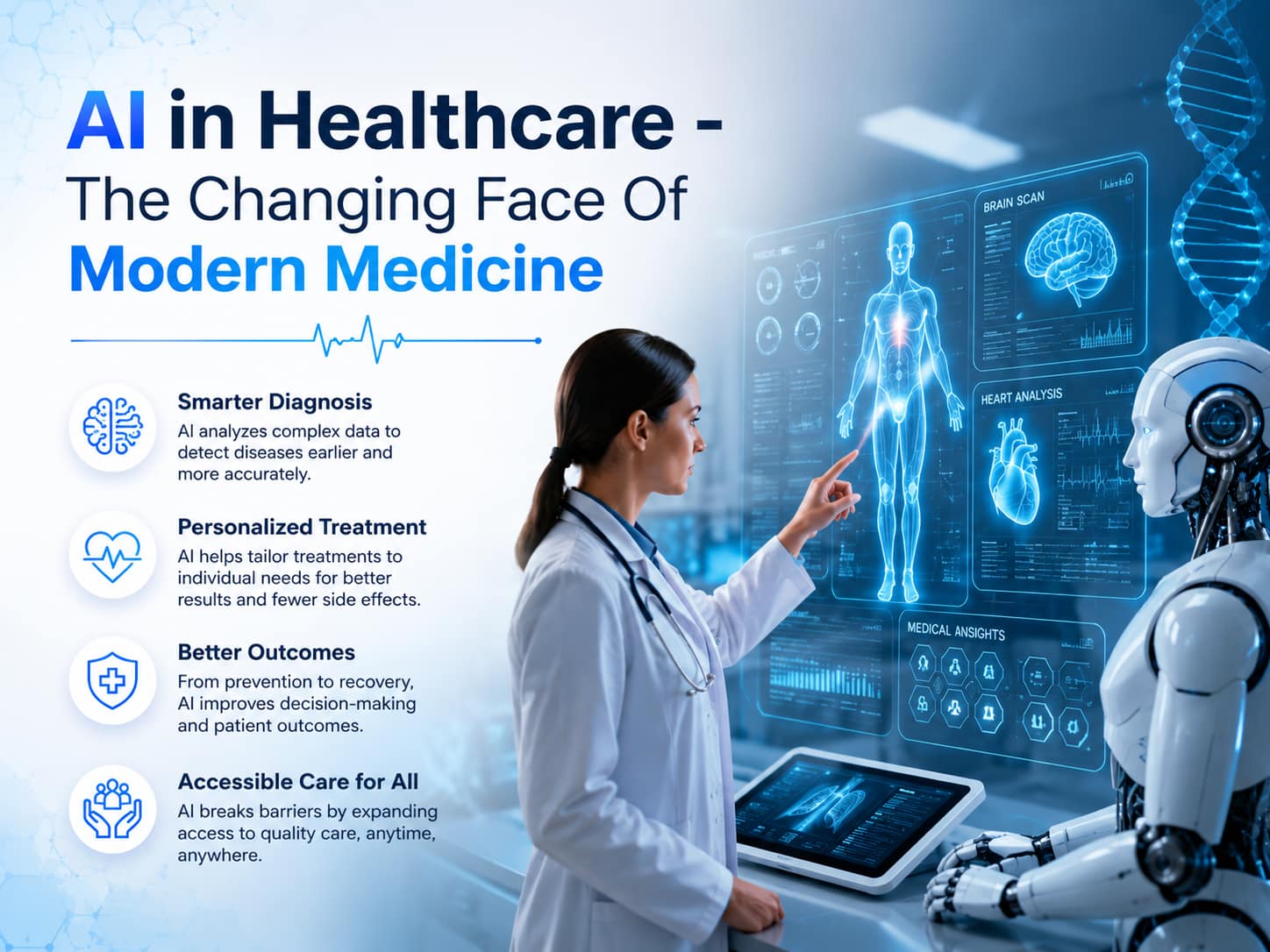
Lets talk about AI in healthcare and its pros and cons…
The evolution of healthcare has continued alongside technology. From the light and portable stethoscope to the single small camera of robotic surgery — each innovation has made it easier for medical professionals to deliver improved care. Another important transition is happening today. AI in healthcare is transforming the detection of diseases, the planning of treatments, hospital management and nursing the patients too! Instead of replacing healthcare workers, artificial intelligence is emerging as a partner in building clinical know-how, increasing efficiency and supporting data-driven decisions.
In the face of pushing patient needs, spiraling operational costs and hefty volumes of medical data within healthcare systems, intelligent technologies are empowering organizations to close the gap. AI in healthcare is moving from just large research institutions to hospitals, diagnostic centers and clinics around the world.
Understanding AI in Healthcare
Artificial intelligence is a type of computer system. It is designed to learn from data, identify patterns, make decisions and predictions based on that.
In the medical field, AI processes large volumes of health data in seconds which an individual could never do. With access to patient records, laboratory reports, medical images, genetic information and clinical research running in parallel as one data processing unit, medical providers are enabled to make better-informed decisions.
The reason AI in medicine is starting to spread across every branch of healthcare is the capacity for these systems to transform very complex medical data into actionable insights.
Read Related – The Future of Artificial Intelligence (AI) in Healthcare
The Ways AI And Medicine Can Impact Each Other
AI actions in the medical field is way more than just automation. These are helping the whole patient journey by improving accuracy, speed and consistency.
Smarter Disease Detection
AI in healthcare is also very good at noticing patterns that you can’t easily spot. Using advanced algorithms, these solutions help radiologists review X-rays, CT scans, MRI images and other diagnostic reports by bringing attention to anomalies that require further examination.
Prior detection oftentimes means prior treatment, which can lead to significantly increased cure rates for a long list of diseases.
Personalized Patient Care
Everyone uniquely reacts to drugs and remedies. Artificial intelligence (AI in Healthcare) creates care plans for physicians based on a patient’s medical history, age, genetics, lifestyle, allergies and other health factors.
The personalized nature of such an approach minimizes overtreatment and improves the probability of a successful outcome.
Faster Drug Research
Historically, new medicines take years of study and research, culminating in extensive clinical trials. AI in healthcare speeds up the early-phase exploration of a drug by rapidly finding good compounds, predicting how they will behave with the body, and eliminating many potential drug candidates.
While laboratory tests and clinical trials are still extremely important, artificial intelligence accelerates the medical innovation pipeline.
Intelligent Hospital Operations
Hospitals handle thousands of daily tasks — scheduling appointments and allocating beds, monitoring medical equipment. These operations are optimized with AI by predicting when patients need to be admitted, optimizing resource planning, minimizing waiting times for services, and automating repetitive routine administrative work.
This allows healthcare personnel to focus on patient care rather than paperwork.
Continuous Patient Monitoring
Nowadays, wearable devices provide us with great health information and also the entire day. This continuous data stream is monitored by AI to discover any sudden changes in heart rate, blood pressure, oxygen levels or even sleeping patterns. These alerts allow care providers to intervene early and reduce complications that may become serious.
The Role of AI in the Healthcare Industry
It has been working really efficiently in almost every aspect of human life, and of course, now that artificial intelligence in the medical field is increasing rapidly, it gives numerous significant benefits both for patients and healthcare establishments.
Greater Diagnostic Confidence
AI in healthcare supports clinicians with analysis of current patient data against a large database of medical knowledge. This extra layer of analysis helps mitigate missed findings and enables more confident diagnoses.
Improved Clinical Efficiency
Healthcare practitioners are accustomed to reviewing records and completing other tasks hours after a good amount of time is invested. AI helps to automate repetitive processes so that doctors and nurses can focus on interacting with patients and making complex clinical decisions.
Enhanced Patient Experience
Digital health platforms help patients by scheduling appointments faster, getting the diagnosis report quicker along with customized treatment recommendations and better communication.
Better Resource Management
Hospitals will have to balance staff and equipment with finances. Also, AI in healthcare can forecast demand, optimize schedules and avoid unnecessary costs while preserving quality care.
Support for Preventive Healthcare
Rather than scope to respond following the onset of disease, A.I. can identify people at a higher risk of illness in the future. That allows for preventative approaches that promote better outcomes and lower future healthcare expenditures.
Challenges That Require Attention
AI is capable of amazing things, but it should be used with caution.
Protecting sensitive patient information remains among the more crucial topics. The healthcare organizations should maintain secure cybersecurity and also adhere to data privacy regulations by implementing all the discussed strategies.
Another important consideration is transparency. The difference, according to health professionals, is that physicians should know how the recommendations are made so they can assess whether or not they’re valid.
Another area that requires proper attention is bias in the training data. Recommendations may not work equally well for every patient population because AIs learn from historical data—and historical data is rarely ever diverse.
Above all, AI in healthcare needs to assist rather than replace physicians’ judgement. Quality healthcare will always need human perspective, emotion, conversation, and moral judgement.
What the Future Holds
There is every chance that the future of AI in healthcare will focus on building increasingly interconnected and proactive systems of health care. In the case of intelligent technologies, it was projected to enhance remote consultations, bolster preventive medicine, expedite medical research and support an increasing complexity in clinical decisions.
I see that advances in predictive analytics, precision medicine, robotic assistance and digital health platforms will further extend the scope of AI to all areas of healthcare. These technologies will allow for an even more seamless collaboration between clinicians and AI systems as they mature.
But success depends on implementing responsibly, constantly evaluating our approaches, and being transparent and ethical to maintain patient trust.
Read Related – Zones of Operation Theatre: Hospital’s Key Areas to Understand
Conclusion
The applications of artificial intelligence in healthcare range from improving the accuracy of diagnosis and streamlining hospital processes to accelerating medical research and supporting preventive care. Organizations that embrace these innovations in an ethical manner will be better positioned to respond to the challenges of tomorrow’s health care environment with more secure, intelligent and compassionate solutions.
The power of AI in healthcare is not in taking clinicians out of the equation, but providing better tools to improve lives – one patient at a time.