

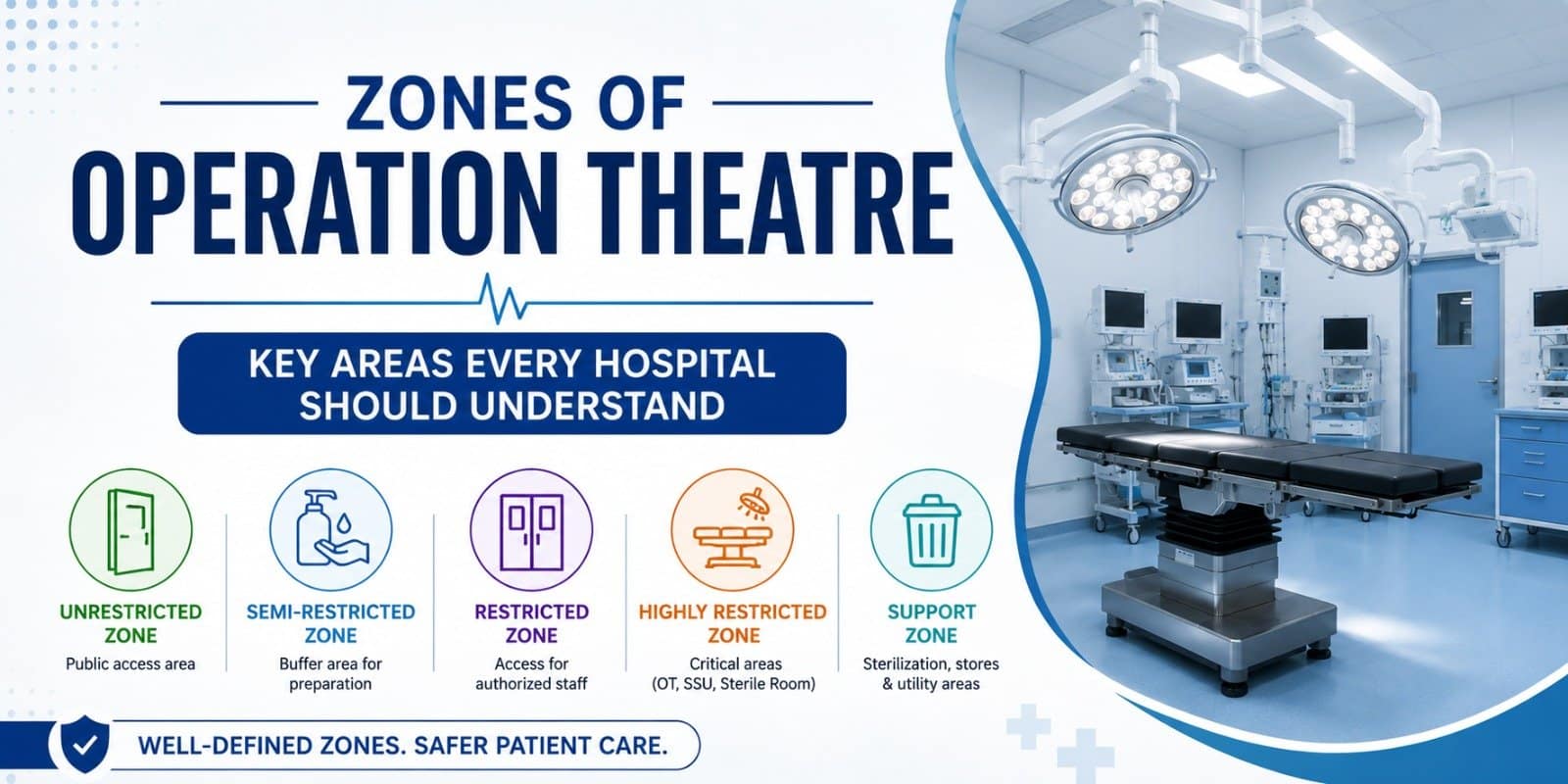
Lets explore the zones of operation theatre here below..
The zones of operation theatre play a critical role in ensuring sterility, patient safety, and efficient surgical workflows. When we think about an operating theatre, many of us imagine a surgeon under bright surgical lights. However, the success of any surgery depends on a carefully planned OT design, where each zone contributes to infection control, workflow management, and overall safety.
Understanding the zones of operation theatre is not just an academic concept for medical professionals. It is a practical necessity for hospital planners, infection control teams, OT nurses, and administrators striving to achieve NABH accreditation and minimize surgical site infections (SSIs).
Why Do OT Zones Exist and What Are They?
It is not just a single open space — an operating theatre. It is a set of areas, planned out in sub-areas, each having its own access restrictions and set of sterility/environmental requirements and functional uses. The zones of operation theatre are defined as:
- Create physical barriers against contamination
- Specify who should be able to enter/leave each area and when.
- Control the movement of patients, personnel, equipment and waste
- Adhere to NABH and global infection control standards
One last explanation on the zoning principle: It rests on a very simple logic, i.e. the closer you get to the patient (in this case, actually lying down on an operating table), the stricter the sterility condition.
4 Zones Of Operation Theatre Explained
Zone 1: Protection Zone Outside
The outer zones of operation theatre complex is the protective zone. It serves as an intermediary space between the noisy hospital environment and a more controlled OT area.
Key features:
-
- Wear what you would in the hospital (nothing special required)
-
- Reception, waiting areas and OT administration offices
-
- Visitors and staff of the general wards and the hospital may enter this zone
-
- Provides a physical and psychological barrier around the OT to separate it from the rest of the hospital
This area comprises a buffer zone, which prevents incidental foot traffic from reaching those more sensitive inner areas of the OT complex.
Read Also This: Classification of Operation Theater: Structure, Function & Standards
Zone 2: Clean Zone (Restriction Area)
Inward, the clean zone is where OT preparation starts. The OT entry is restricted to authorised personnel only – even at the entrance, you need a special access card and everyone coming in should change into OT-only scrubs, caps and footwear.
Key features:
-
- Scrub sinks, pre-operative preparation rooms, anaesthesia bays and staff changing rooms
-
- Surgeons and nurses perform hand scrubbing here before entering the sterile field
-
- This area is for the transfer of patient trolleys from hospital stretchers to OT trolleys
-
- Instruments are unpacked and readied for sterilisation or sent from the CSSD (central sterile supply department)
The clean zones of operation theatre are the vital areas ensuring that contamination is filtered out before it can breach the sterile zone when performing surgery in a modular operation theatre.
Zone 3: Sterile Zone (Aseptic Zone)
This is the Heart of the whole OT complex —the Sterile zones of operation theatre where the desired surgery is performed. This requires the most stringent access control and the highest demand for infection control.
Key features:
Consists of the physical space it occupies, instrument trolleys, and the surgical field
-
- Surgical team members are not fully robed and gowned.
-
- Ultra-clean air quality is maintained by Laminar Airflow (LAF) systems and HEPA-filtered air
-
- The air pressure input is introduced to maintain positive air pressure within the chamber and shut out outside air.
-
- All materials coming into this zone need to be sterile — no exceptions.
It is a sterile area with respect to the patient — contamination of this zone [a dirty glove, an unsterile instrument, or someone entering without proper scrubbing] can be translated directly into a surgical site infection in a patient.
The sterile zone is what all other zones of operation theatre are designed to protect.
ZONE 4: Waste Area (DIRTY ZONE)
Disposal zone: This is the exit route for all surgical waste. It is intentionally separated from the accessways to avoid cross-contamination.
Key features:
-
- Takes care of used instruments and linens, as well as surgical waste and bodily fluids
-
- Has pathways that are reserved and do not cross near clean or sterile areas
-
- Direct integration with the hospital’s waste management and CSSD systems
In this zone, materials are handled by staff in accordance with strong PPE protocols.
An effective OT ensures that the flow of junk-free material and waste does not cross the clean-to-dirty barrier.
Sub-Zones Within the OT Complex
In addition to the four major zones of operation theatre, modern hospitals also have classified some sub-regions inside the wide OT complex similarly.
Scrub Area — Specialized hand-washing stations next to the operating room
Anaesthesia Room: Patients are anaesthetised before they go to the OR
Recovery Room (PACU): Post-Anaesthesia Care Unit to recover patients from surgery
CSSD Interface: A pass-through window or a dedicated corridor connecting the OT to the Central Sterile Supply Department
The Sterile Store — A controlled room for storing sterilised instruments and consumables at a regulated temperature/humidity
Access protocols and environmental standards vary for each sub-zone.
Zone Movement Rules: The Non-Negotiables
The movement of people and materials between zones of ot is one of the most important — and least adhered to! Key rules include:
Traffic: Clean and dirty flows in one direction only. Staff flow, material flow from clean to dirty.
No Re-entry without re-scrubbing: Team members are only allowed to exit the sterile zone and must scrub each time they re-enter
Protection of OT specific footwear: OT shoes should not be used away from the OT area
Instrument tracking: All sterilized instruments entering Zone 3 need to be trackable and disposed of or re-sterilised post usage
These are not procedural — these rules are the last line of defence against preventable infections.
OT Zones and NABH Compliance
Accreditation surveys by the National Accreditation Board for Hospitals (NABH) assess OT zone design and compliance. NABH assessors check for:
-
- All four zones should have a clear physical boundary
-
- Correct signage outlining the boundaries of each zone and rules regarding access
-
- Evidence of staff instruction on zone protocols
-
- Clean & Dirty Corridors Functional Separation
-
- Positive pressure in the sterile area
Hospitals unable to showcase the adequacy of zones of operation theatre compliance often face procrastination in getting and/or conditional approvals.
Wrapping Up
The surgical zones of operation theatre form the fundamental block from which safe surgical care is envisioned, architecturally and functionally. The outer protective zone to the innermost sterile zone and in between, nothing is by chance; each zone has an important and irreplaceable role.
Designing zones of operation theatre the right way is not optional; pour over this detail if you are designing a new OT, or renovating an existing one, or preparing yourself to face NABH accreditation, because this can derail even the best surgical procedure.
Frequently Asked Questions (FAQs)
Q1 In an operation theatre, what is the protective area?
The outermost layer of the OT complex is open to non-OTHB hospital staff. It serves as a barrier between the opportunistic hospital and the noble OT.
Q2 Do we have to demarcate zones for NABH?
Yes. For any OT zone, NABH mandates that it must be physically demarcated, properly signed, and staff trained on the processes therein.
Q3. Know the self PACU and which OT zone?
PACU = Post-Anaesthesia Care Unit (recovery room). The clean zone, it is where patients stabilise following surgery.
Q4 Can a scrubbed member of staff leave the sterile zone and return?
No. Any team member who is scrubbed and leaves the sterile side must fully re-scrub to avoid contamination.
Q5 What airflow systems are used in the sterile zone?
Laminar Airflow (LAF) is an ultra-clean, particle-free air that flows through LAF with HEPA filtration in the sterile zone of the operation theatre.