

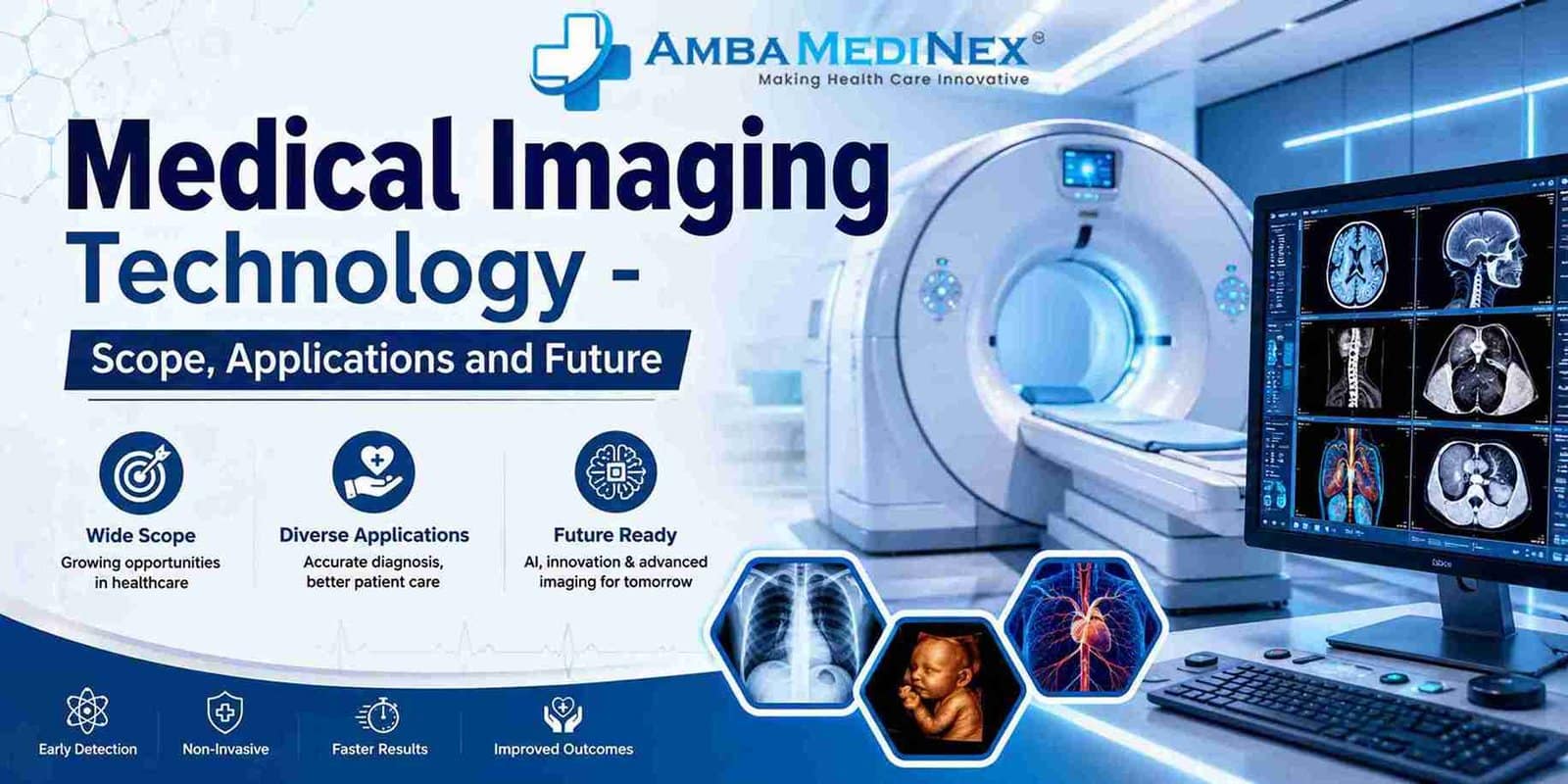
The incorporation of imaging into medicine radically transformed the methods by which clinicians detect, evaluate, and treat disease [1]. Rather than relying solely on physical exams and lab tests, doctors can see inside a patient through advanced imaging modalities as MRI allows for visualization of internal organs, tissues, bones and other structures of the body.
The field has evolved from traditional x-rays to compounding more advanced MRI, CT, ultrasound and AI-assisted imaging systems. A surge in healthcare infrastructure and technological innovation has expanded the medical imaging technology scope throughout hospitals, diagnostic centres, research facilities, emergency care and specialised medical departments.
What Is Medical Imaging Technology?
Medical imaging technology is the device, technique and digital systems for creating images of systems or functions in the human body. These images are a rich source of information used by healthcare professionals that can aid all three processes: diagnosis, treatment planning and patient monitoring.
A few of the popular technologies for medical imaging here are:
- X-ray imaging
- Computed Tomography (CT)
- Magnetic Resonance Imaging (MRI)
- Ultrasound
- Mammography
One modality works differently than the other, with specific clinical applications associated with each. The choice of imaging method depends on the symptomatology, clinical picture and requirements of the diagnosis.
Read Related – Operation Theatre Technology – A Complete Guide to OT Technology
Importance Of Medical Imaging Technology
Misinformation is not the best in making medical decisions. Medical imaging can strengthen your diagnosis with visual documentation of the abnormalities not apparent on physical examination alone.
For instance, X-rays are widely used to see bone or some chest issues. CT has better cross-sectional images and MRI would be helpful in soft tissue evaluation, brain, spine, joints etc. Ultrasound is real-time imaging that we use very often in obstetrics and many other medical scenarios.
It can help healthcare professionals follow the progress of a disease and determine if a patient is responding to treatment through imaging.
Medical Imaging Technology Scope
In older times, the focus of medical imaging technology was primarily on a conventional diagnosis. Digital Health advances have put imaging in these critical areas.
- Diagnostic Healthcare
One of the most salient applications of medical imaging continues to be diagnosis. Information on fractures, tumours, infections (934), organ abnormalities (933), vascular conditions or other diseases is also supported by imaging for clinicians.
- Cancer Diagnosis and Management
Introduction Imaging More than Just Pictures of Tumor Several imaging modalities can also suggest the presence of suspicious lesions, assess the extent of disease in a patient, help direct treatment planning or follow-up and monitor changes over time.
- Emergency and Trauma Care
Rapid and accurate imaging increases in value most acutely for emergency departments. CT, X-ray, ultrasound and other imaging methods are used to explore injuries, internal bleeding, fractures and other critical circumstances.
- Treatment Planning
Before any medical treatment can be performed, doctors must understand the location and features of a condition through various forms of medical imaging. Imaging can be used to optimize surgical, radiation therapy,, minimally invasive procedures or other kinds of interventions as well.
- Image-Guided Procedures
Imaging is increasingly used in modern healthcare for guiding selected minimally invasive procedures. Real time imaging will allow healthcare professionals to both guide instruments as well as monitor certain procedures.
- Preventive Screening
Some imaging modalities are included among particular screening programmes for specific types of diseases. For example, breast cancer screening according to appropriate clinical recommendations by mammography.
The Role of Artificial Intelligence in Medical Imaging
The role of artificial intelligence in medical imaging technologies & devices As you are all aware, these AI-based systems can help in image analysis, segmentation, reconstruction workflow prioritisation and identification of certain patterns.
Overall AI in medical imaging has been mainly developed to augment practitioners, rather than replace clinical mindset. Well-validated AI tools may assist radiologists and other specialists in managing the vast amounts of imaging data created each day, as well as spotting results that should be reviewed more closely.
The medical imaging applications have a high potential to grow since, as AI algorithms continue improving.
Benefits of Advanced Medical Imaging
Modern imaging technologies offer a number of advantages when used and selected appropriately:
- Detailed visualisation of internal structures
- Assistance in Identifying Certain Irregularities Sooner
- Assistance with treatment planning
- Monitoring of disease progression
- Support for minimally invasive procedures
Future of Medical Imaging Technology
Artificial intelligence, automation, advanced image reconstruction (including deep learning), improved detectors, cloud-based platforms and electronic health record integration: these capabilities likely define the future of medical imaging technology.
Portable and point-of-care imaging devices might also extend diagnostic capabilities out of traditional imaging departments. These technologies are increasingly useful in emergency care, smaller healthcare facilities and wherever access to large imaging systems is limited.
Another promising direction is the combination of imaging data with other clinical information. Further integrating imaging, laboratory results, patient history and other healthcare data might facilitate more sophisticated clinical decision-making.
Choosing Medical Imaging Infrastructure
While designing imaging facilities, healthcare organisations need to keep in mind more than just the imaging equipment. Facility planning must be a consideration of room design, electrical infrastructure, ventilation, patient workflow, equipment positioning, safety requirements, data connectivity and maintenance.
With a professionally designed imaging environment, hospitals are able to optimize the utilization of their available technology while maintaining a structured experience for both patients and healthcare personnel alike.
Ambamedinex and Modern Healthcare Infrastructure
Ambamedinex offers hospital and healthcare infrastructure along with medical equipment for hospitals, diagnostic centres, clinics, and other healthcare facilities. With continuous advancement in medical technology, the provision of infrastructure is key to supporting high-end healthcare gadgets.
Ambamedinex tailors its solutions to your project requirements, offering practical quality and/or capital sector solutions across specialised hospital infrastructure or medical equipment.
Read Related – Medical Equipment Manufacturers in India
Conclusion
Medical imaging technology has transformed the diagnosis and management of patients in modern medicine. Techniques available today—X-ray, CT, MRI, ultrasound, and nuclear imaging—are providing physicians with more detailed information about what is happening within the human body.
Frequently Asked Questions
What is medical imaging technology?
Medical imaging technology employs the use of specialized equipment and digital technology to create images of internal body structures for diagnosis and treatment planning.
Classes of a Medical Imaging
There are 5 primary classes of medical imaging — CT scan, ultrasound, MRIs, X-ray and PET scans.
The most typical forms are X-ray, CT, MRI, ultrasound, mammography, fluoroscopy (high definition visuals), positron-emission tomography and also nuclear medicine imaging.
What are the horizons of medical imaging technology?
The tracks include diagnosis, emergency medicine, treatment planning, imaging guidance in procedures, cancer care and screening as well as research and AI-supported image analysis.
How is the medical imaging used in AI?
AI is widely used for image analysis (including reconstruction, segmentation), workflow prioritisation, and pattern detection in medical images.