

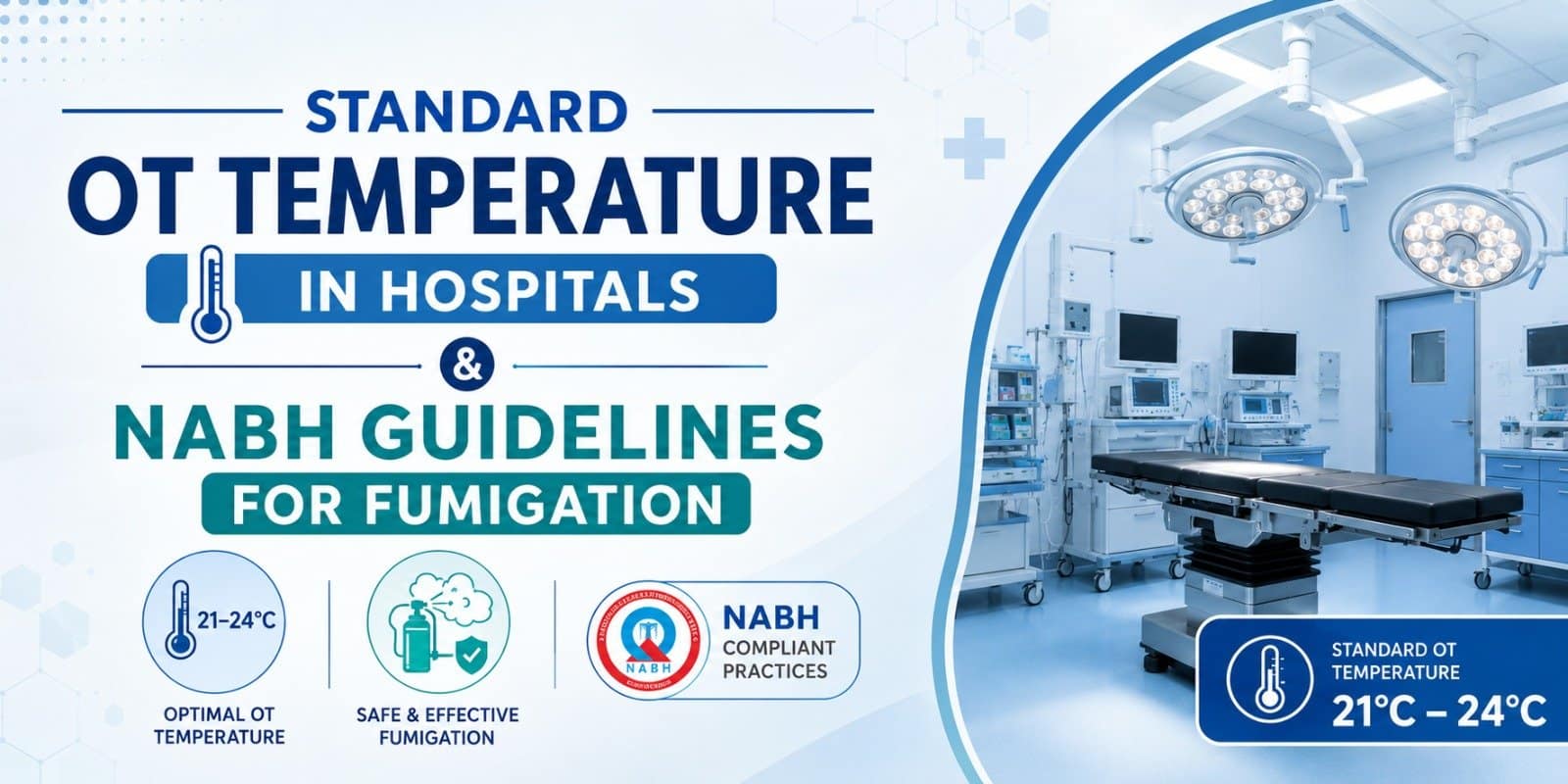
The OT is one place, in any hospital, where precision counts; and that precision goes beyond the surgeon’s hands. Environmental factors such as normal OT temperature, humidity, and fumigation protocols are critically important determinants of surgical outcomes and patient safety. However, these parameters are neglected during OT planning and maintenance.
In this blog, we discuss everything you need to know about normal OT temperature, humidity in operation theatre and NABH guidelines for OT fumigation — the 3 major pillars of a safe and compliant surgical environment.
Why OT Environmental Controls Matter?
An unmaintained OT environment could result in:
Microbial growth in optimal conditions (the warmth and humidity of a surgical site) -> Surgical Site Infections (SSIs).
Мalfunction of the equipment due to condensation or static electricity
Cold OT without active warming (negative influence in synergy) – hypothermia in pts.
The importance of regulatory compliance is reflected in the fact that many NABH accreditations fail on this ground.
Not merely comfort but clinical necessity as well as national and international standards have raised the bar when it comes to controlling OT temperature and humidity.
What Is Normal OT Temperature?
Safe OT temperature for a major operation theatre in India: The normal atmospheric OT temperature recommended for large procedure theaters is 18°C to 24°C (64°F to 75°F). But that is not a universal number. What the correct tempe
rature should be is also dependent on the type of surgery taking place.
Temperature Guidelines by Surgery Type
General & Abdominal Surgery
18°C – 22°C
Cardiac Surgery
16°C – 20°C
Neonatal & Paediatric Surgery
26°C – 28°C
Burns Surgery
28°C – 32°C
Orthopedic Surgery
18°C – 22°C
Other surgical OTs, such as neonatal and burns surgery OTs, are kept much hotter to avoid heat loss from the patient,t whilst cardiac OTs are generally cooler due to favourable conditions for controlled hypothermia protocols.
Read Also This: Enhancing Hospital Infrastructure for Better Care
Why You Should Keep It At The Right Temperature
Warm (> 24°C) temperature: Supports bacterial growth, increases the surgeon’s tiredness and promotes the chances of infection
Hypothermia: the temperature of the anaesthesia machine at the delivery port should not be too cold (> 18 °C) or else it creates a perioperative hypothermia risk, particularly in elderly/neonates.
Variations: Rapid temperature changes impact anaesthesia administration and patient recovery
As per NABH standards, continuous monitoring and logging of OT temperature are required for OT compliance.
Humidity in operation theatre is as important as temperature, though it draws less attention than temperature. Relative humidity (RH) for major OTs should be in the range of 45% to 60%.
Why Humidity Control Matters?
Excessively high (higher than 60% RH): Provides a humid environment favorable for bacteria and fungi; promotes condensation on sterile surfaces and instruments.
Too low (less than 45% RH): Increases static electricity risk, leading to potential ignition of anaesthetic gases; causes drying of mucosal surfaces in intubated patients
The HVAC system (Heating, Ventilation & Air Conditioning) built into the OT governs humidity. Why modular OTs are cost-effective. Modular OTs are relatively better equipped with humidity sensors and automated controls, so compliance is a lot easier.
NABH Guidelines for OT Fumigation
Fumigation refers to the decontamination of the OT using chemical agents that destroy airborne and surface pathogens. NABH guidelines for OT fumigation are among the infection control policy framework for accredited hospitals in India.
When Should the OT Fumigation Be Performed?
The OT fumigation is recommended according to NABH and routine infection control, A surgery, infected or contaminated, Following a breach in sterility that was known to them. Weekly or fortnightly part of routine maintenance depends on OT usage and hospital practice, from renovation or new construction work near the OT.
Following a suspected or confirmed outbreak of Hospital-Acquired Infection (HAI) –
Approved Fumigation Agents
Types of fumigants Most commonly used and accepted by NABH (4,5) for OT decontamination include the following:
-
- Maximum efficacy but exposure time (≥6–8 hours) and proper sealing of OT is important — Formalin + KMnO₄
-
- Hydrogen peroxide vapour (HPV): Latest, no residue, effective; increasingly getting used in NABH-accredited hospitals
-
- Sprays with glutaraldehyde: A spray that is based on glutaraldehyde, used for surface decontamination after surgery
NABH Fumigation Protocol − Major Steps
Purge the OT of all folks and non-essential kit, seal all gas leakage points, including vent, gap, and door.
Activate the fumigant at the specified concentration. Observe contact time (AT LEAST 6 HOURS, for formaldehyde-based fumigation)
Air Changes & Pressure: The Extremely Offers Parameters Soon After
Two additional parameters that help to characterize a compliant OT environment, along with temperature and humidity, are :
Air Changes per Hour (ACH): NABH required 20 ACH for major OTs with super-speciality OTs needing even up to 25 ACH. Positive pressure /Pressure between OT & adjacent corridors shall be positive to keep outside air — contaminant free OUT of sterile zone. And combined with temperature and humidity control, these parameters ensure a real sterile surgical room.
Continuous Monitoring: A NABH Non-Negotiable
The hospitals accredited by NABH should continuously maintain environmental monitoring logs for the OT temperature, in which:
-
- Hourly temperature and humidity readings
-
- Verify that you are positive pressure each day
-
- Weekly/fortnightly fumigation records
-
- HEPA filter inspection and replacement logs (quarterly)
One of the most frequently cited reasons why hospitals lose or fail to achieve NABH accreditation is failure to keep such records.
Conclusion
Not just compliance checklist items, but the normal OT temperature, humidity in operation theatre, and strict adherence to NABH guidelines for OT fumigation are lifeline benchmarks. For patients on the operating table, every degree of temperature variance, every percentage point of humidity deviation and every missed fumigation cycle is a potential hazard.
As surgical skill is to you, building a culture of environmental compliance in your facility whether you are a hospital administrator/ an infection control officer/OT in-charge as the case may be.
Frequently Asked Questions –
Q1. Normal OT temperature according to NABH?
The major OTs perform well at a range of OT temperatures from 18 °C to 24 °C, higher than this for neonatal (26 °C–28 and for burns surgery, a minimum of 28 °C –32 °C.
Q2. What must be the humidity in an operation theatre?
45% to 60% RH is the UAE’s ideal relative humidity. As this range is crossed, infection risk and equipment hazards are far greater.
Q3. How many times should OT fumigation be done?
Normally weekly or fortnightly as part of routine maintenance and then immediately after any infected surgery, breach of sterility.
Q4. What is the best fumigant for OT decontamination?
Away with the traditional cleaning and here is the new and current favourite — Hydrogen Peroxide Vapour (HPV) — a great cleaner to go with as it contains no residue after its use. Formaldehyde is a powerful ingredient, but it needs to have tight controls in the way it is handled.
Q5. What is the minimum ACH for a big OT?
NABH requires a minimum of 20 Air Changes per hour (ACH) for the main OT.